Kitchen Countertop Installation in the Quad Cities
New countertops can change the look and daily function of a kitchen without requiring a complete remodel. We install and replace kitchen countertops in the Quad Cities, coordinating material selection, measurements, sink and cooktop cutouts, edges, removal and installation with the cabinets and the rest of the kitchen.
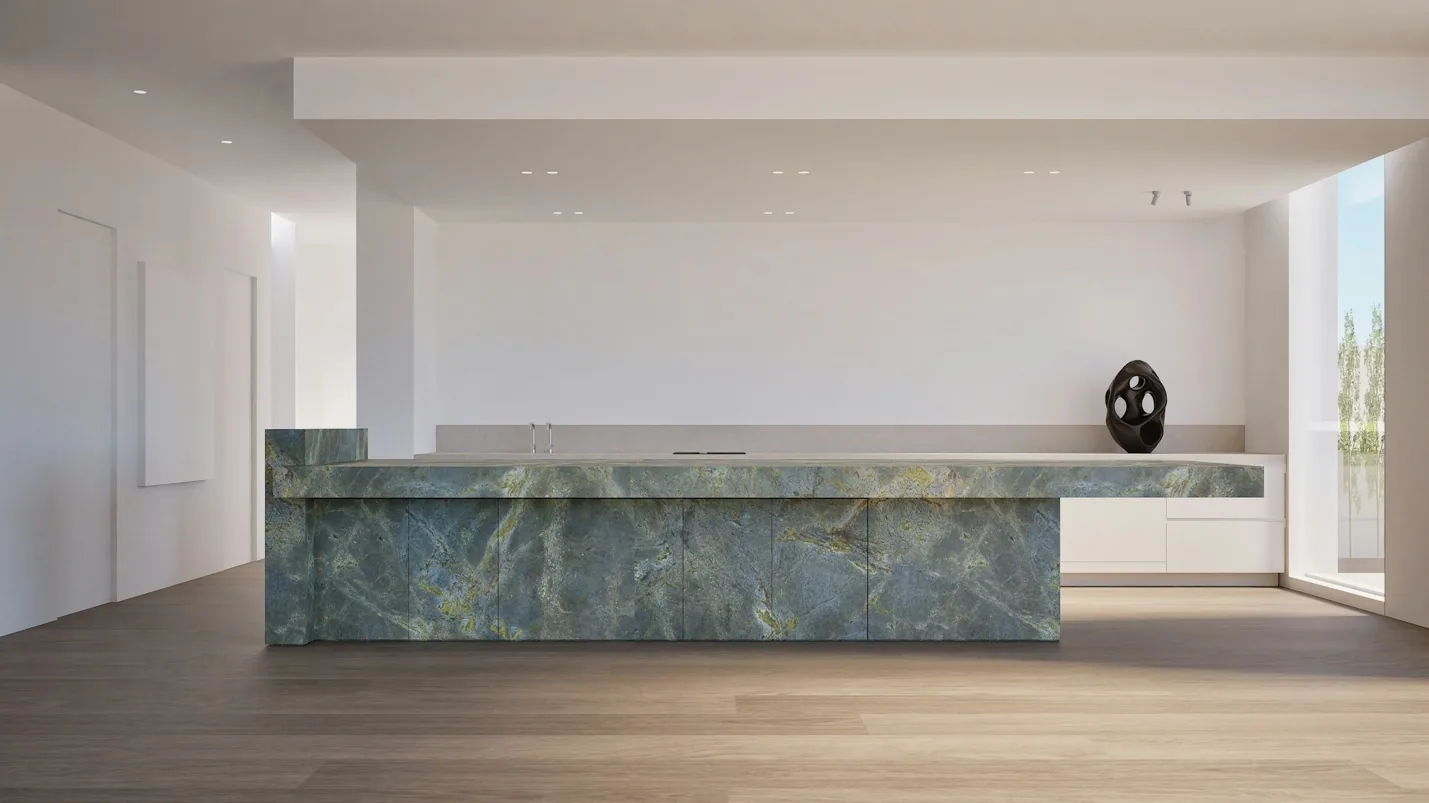
A countertop project may be as simple as replacing worn laminate while keeping the cabinets, or it may be part of a larger kitchen renovation involving new cabinets, an island, a sink, backsplash and appliance changes. The right scope depends on what is wrong with the existing kitchen and how much you want to change.
This page focuses on kitchen countertop installation and replacement. For a complete room renovation, see Kitchen Remodeling. If the cabinets are also being replaced, see Kitchen Cabinet Installation & Replacement. Countertops can also be coordinated with bathroom vanity projects through Bathroom Vanity Installation.
Kitchen Countertop Services
Countertop work can be scoped around the existing kitchen or coordinated with a larger renovation. Common projects include:
- Kitchen countertop replacement: remove old counters and install new surfaces while retaining suitable cabinets.
- Quartz countertops: low-maintenance engineered stone in a wide range of colors and patterns.
- Granite countertops: natural stone with substantial variation from slab to slab.
- Quartzite countertops: natural stone selected for its appearance and durability, with material-specific care requirements.
- Laminate countertops: practical, economical surfaces available in many colors and patterns.
- Butcher block and wood countertops: warmer-looking surfaces that require different maintenance than stone.
- Island countertops: larger tops, seating overhangs, waterfall edges and special layout considerations.
- Sink and faucet cutouts: openings coordinated with undermount, drop-in or other sink configurations.
- Cooktop cutouts: precise openings coordinated with the appliance dimensions.
- Edge profiles and finishing: eased, rounded, beveled, mitered and other edge treatments depending on the material.
- Countertop removal: removal and disposal of existing tops when the project requires it.
- Countertop and backsplash coordination: planning the transition between the new counter, wall tile and cabinetry.
Choosing Quartz, Granite, Quartzite or Another Countertop
There is no single material that is right for every kitchen. The useful comparison is between appearance, maintenance, durability, budget and how the kitchen is actually used.
Quartz is an engineered surface made from mineral material and resin. Homeowners often choose it for consistent appearance, broad color selection and relatively low maintenance. It is particularly attractive when you want a stone-like surface without the sealing routine associated with some natural stones. It is still important to follow the manufacturer's care instructions and heat limitations.
Granite is natural stone, so each slab can have its own movement, color and pattern. It remains a strong option for homeowners who want genuine stone variation. Depending on the particular granite, sealing and periodic maintenance may be appropriate.
Quartzite is also natural stone and is often selected when homeowners want dramatic stone movement with a hard surface. The name matters because quartz and quartzite are not the same material. The specific slab should be evaluated rather than choosing solely from a small sample.
Laminate can make sense when budget, color choice and a straightforward installation are priorities. Modern laminate can imitate stone and other materials and is considerably different from the older patterns many homeowners remember.
Butcher block adds a warmer wood appearance and can work especially well on islands or selected prep areas. It requires a different maintenance routine and should be chosen with that maintenance in mind.
Local Quad Cities suppliers and remodelers commonly present quartz, granite and laminate as distinct choices with different advantages and tradeoffs.
Do You Need New Cabinets to Replace the Countertops?
No. A countertop replacement can often be completed while keeping existing cabinets if the cabinet boxes are sound, adequately supported and the new layout does not require cabinet changes.
This can be a useful middle-ground renovation. If you like the current cabinet layout but the counters are dated, damaged or difficult to maintain, new countertops can make a large visual change without the cost and disruption of replacing the entire kitchen.
There are, however, situations where cabinets should be addressed first. If the boxes are damaged, the layout wastes space, an island needs to be added, an appliance must move, or the cabinet footprint needs to change, the countertop should generally follow the cabinet work. New countertops are templated to the actual installed footprint, so the cabinet installation needs to be settled before fabrication.
What Happens During Countertop Installation?
A professional countertop installation is a sequence of measuring, templating, fabrication and installation rather than simply carrying a slab into the kitchen.
- Evaluate the existing kitchen: cabinet condition, counter dimensions, wall conditions, sink, appliances and access are reviewed.
- Select the material: choose the surface, color/pattern, finish and edge treatment.
- Confirm the sink and appliances: sink type, faucet holes, cooktop openings and other cutouts are established before fabrication.
- Complete cabinet work first: if cabinets are being replaced, they are installed, leveled and secured before final templating.
- Template the actual kitchen: measurements are taken from the installed conditions so corners, walls, cutouts and seams can be fabricated accurately.
- Fabricate the countertop: the material is cut, finished and prepared for the specified sink, cooktop and edge profile.
- Remove the old countertop: when replacing an existing top, removal is coordinated to protect the cabinets and surrounding finishes as much as possible.
- Install and level: the new countertop is positioned, joined where necessary and secured appropriately.
- Complete cutouts and finishing: sink, cooktop, backsplash transitions, caulking and other finishing details are addressed.
Countertop Seams, Edges and Sink Cutouts
Homeowners often focus on the slab itself and underestimate how much the fabrication details affect the finished kitchen.
Seams are sometimes unavoidable, particularly with large islands, long runs or materials that require multiple pieces. Their placement should be planned around the layout and visual characteristics of the material. Veined materials can require additional planning so the pattern transitions as naturally as possible.
Edge profiles change the visual weight of the counter. A simple eased edge can keep a modern kitchen clean, while a more substantial or mitered edge can create a furniture-like appearance on an island.
Sink cutouts need to match the actual sink configuration. An undermount sink requires a different finished opening than a drop-in sink, and the faucet configuration needs to be known before fabrication. The same principle applies to cooktops and specialty appliances.
These details are not minor add-ons. Sink holes, additional cutouts, edge profiles, waterfalls, seams and templating all affect the final quote.
Kitchen Countertop Cost: What Changes the Price?
Countertop pricing varies substantially because the material is only one part of the finished project. Square footage, number of slabs, layout complexity, cutouts, edge work, seam requirements, tear-out and installation conditions all affect the quote. These are market references, not a Quad Cities quote, and should not be treated as a price promise for a particular kitchen. A 55-square-foot granite project was reported at $1,800 installed, while other homeowners described several-thousand-dollar quotes for much smaller areas when premium quartz or quartzite and more complicated fabrication were involved. The difference is not necessarily an apples-to-apples comparison because material, location, fabrication and scope vary.
When comparing estimates, ask for the scope behind the number. A useful countertop quote should make clear whether it includes:
- Countertop material and selected color/slab
- Template and fabrication
- Edge profile
- Sink and faucet holes
- Cooktop cutout
- Seams and seam finishing
- Old countertop removal and disposal
- Installation and leveling
- Sink installation or plumbing reconnection
- Backsplash removal or installation
- Cabinet reinforcement if needed
- Special island, waterfall or mitered-edge work
Remodeling Across the Quad Cities
Housing age and room layouts vary throughout the region. For community-specific context, see the dedicated pages for Davenport, Bettendorf, Moline, Rock Island, East Moline, Silvis, Milan, Eldridge and LeClaire.
Ready to Replace the Kitchen Countertops?
If the cabinets work but the countertops do not, a countertop replacement can update the kitchen without turning it into a full renovation. If the cabinets, layout or storage also need to change, the countertop project can be planned as part of a complete kitchen remodel. We can start with the actual kitchen and the scope you want rather than assuming you need an entire renovation.
Call (563) 526-7660 or use the request form to discuss your kitchen countertop project.